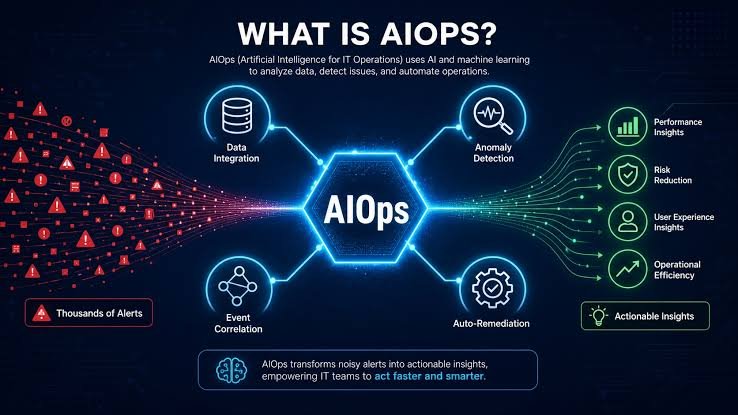

AIOps, or Artificial Intelligence for IT Operations, is the use of artificial intelligence, machine learning, automation, and data analytics to improve how organisations monitor and manage IT environments. It helps IT teams analyse large volumes of operational data, identify patterns, detect anomalies, and respond to incidents more efficiently.
Modern IT environments generate massive amounts of data from networks, applications, cloud platforms, servers, security tools, and other infrastructure. Managing this information manually can be difficult, especially when IT teams receive thousands of alerts every day.
AIOps helps reduce this complexity by connecting data from different systems and turning it into actionable insights. Instead of investigating every alert separately, IT teams can use AIOps to identify patterns and potential root causes.
What Is AIOps and How Does It Work?
AIOps combines artificial intelligence with IT operations data. It collects information from multiple sources, including monitoring platforms, infrastructure logs, network devices, cloud environments, applications, and security systems.
The platform then analyses this data to identify unusual patterns or relationships between events.
For example, a network issue may generate alerts across several servers and applications. A traditional monitoring system may treat these as separate incidents. An AIOps platform can help correlate the events and identify whether they are connected to the same underlying problem.
This can reduce alert noise and help IT teams focus on incidents that require attention.
Key Capabilities of AIOps
One of the main capabilities of AIOps is anomaly detection. AI and machine learning can analyse normal system behaviour and identify unusual changes that may indicate a potential problem.
Event correlation is another important capability. Modern IT environments often generate multiple alerts from a single incident. AIOps can help connect related events and reduce duplicate alerts.
Root cause analysis can also become faster. By analysing relationships between infrastructure components and operational events, AIOps can help teams investigate the likely source of a problem.
Automation is another major component. AIOps platforms can trigger predefined actions when certain conditions are detected, reducing the need for manual intervention in repetitive tasks.
Why Is AIOps Important?
Traditional IT operations often rely on manual monitoring and reactive troubleshooting. This approach becomes increasingly difficult as organisations adopt hybrid cloud, multi-cloud, distributed applications, and remote infrastructure.
AIOps helps organisations move towards a more proactive operating model.
Instead of waiting for users to report a problem, IT teams can identify unusual activity earlier. By analysing operational data continuously, AIOps can help detect performance issues before they significantly affect business services.
It can also improve operational efficiency by reducing alert fatigue. When IT teams receive too many unrelated alerts, identifying critical incidents becomes more difficult. Event correlation and intelligent prioritisation can help reduce this noise.
Benefits of AIOps
AIOps can improve incident detection and response by helping IT teams identify potential problems more quickly.
It can also provide better visibility across complex infrastructure. Organisations using multiple monitoring tools may struggle to understand how events across networks, cloud environments, and applications are connected. AIOps can help bring these insights together.
Automation can reduce repetitive work and allow IT teams to focus on more complex tasks.
AIOps can also support better decision-making. By analysing historical and real-time operational data, organisations can identify recurring problems, performance trends, and potential infrastructure risks.
However, AIOps is not a replacement for skilled IT professionals. AI-generated insights and automated actions still require appropriate governance and human oversight, particularly for critical systems.
AIOps vs Traditional IT Operations
Traditional IT operations typically depend on separate monitoring tools and manual investigation.
When an issue occurs, teams may need to review logs, dashboards, alerts, and infrastructure data individually to identify the problem.
AIOps introduces intelligence and automation into this process.
It can analyse large amounts of data more quickly, identify correlations between events, and highlight patterns that may be difficult to detect manually.
The difference is not that traditional monitoring becomes unnecessary. Monitoring tools continue to provide important data. AIOps adds an intelligence layer that helps organisations analyse and act on that data more effectively.
How Tata Communications Supports Intelligent IT Operations
Tata Communications provides network, cloud, cybersecurity, and managed services that support enterprises operating increasingly complex digital environments.
Its Digital Fabric approach brings together network, cloud, security, interaction, and IoT capabilities to help organisations manage distributed infrastructure.
Tata Communications also focuses on observability, automation, and intelligent operations through ThreadSpan™, an AI-powered platform designed to provide greater visibility and control across hybrid infrastructure.
For organisations exploring AIOps, this type of integrated approach can help reduce operational silos and provide a clearer view of how infrastructure components are performing.
By combining AI-driven insights with network, cloud, security, and managed service capabilities, Tata Communications can support businesses working towards more proactive and intelligent IT operations.
Common AIOps Use Cases
AIOps can be used to monitor infrastructure performance and identify anomalies across complex IT environments.
It can support incident management by correlating related alerts and helping teams prioritise significant events.
Network operations can also benefit from AIOps by identifying unusual traffic patterns, performance degradation, and potential infrastructure issues.
In cloud environments, AIOps can help organisations monitor dynamic workloads and identify resource or performance problems.
AIOps can also support capacity planning by analysing historical trends and helping teams understand future infrastructure requirements.
Conclusion
AIOps uses artificial intelligence, machine learning, analytics, and automation to improve IT operations. It helps organisations manage the growing complexity of modern digital infrastructure by analysing large volumes of operational data and turning them into useful insights.
By supporting anomaly detection, event correlation, root cause analysis, and automation, AIOps can help IT teams reduce alert fatigue, resolve incidents faster, and take a more proactive approach to infrastructure management.
Tata Communications supports this evolution through its network, cloud, cybersecurity, and managed services capabilities. With intelligent platforms such as ThreadSpan™ and a focus on observability and automation, Tata Communications can help enterprises build more efficient and resilient IT operations.