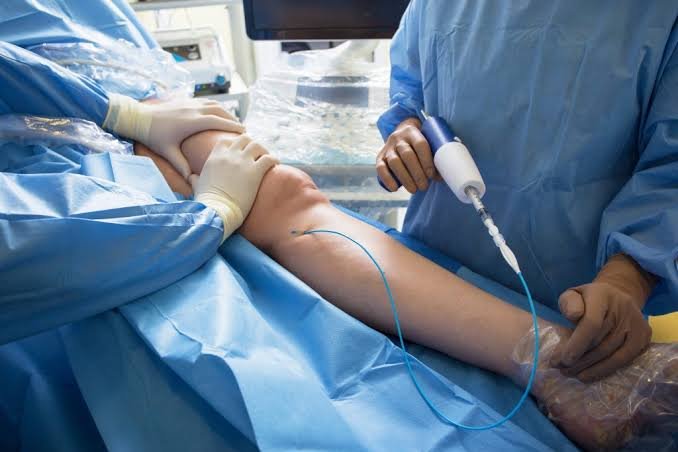

Glue treatment of varicose veins is a minimally invasive procedure that uses a medical adhesive to close an affected vein. Unlike thermal treatments that use heat, glue treatment closes the vein without intentionally heating the surrounding tissue, which can make the recovery experience different for selected patients.
What Is Glue Treatment for Varicose Veins?
Glue treatment, also called cyanoacrylate adhesive closure, involves placing a catheter inside the problematic vein and delivering a small amount of medical adhesive at selected points.
The glue seals the vein, stopping blood from flowing through the treated vessel. Blood is then redirected through healthier veins.
The body gradually absorbs the treated vein over time.
This approach is primarily used for selected patients with superficial venous reflux and varicose veins. A vascular specialist determines whether the anatomy and underlying vein problem are suitable for this treatment.
How Does Glue Treatment Differ From Thermal Ablation?
The major difference is how the vein is closed.
Endovenous thermal procedures, such as radiofrequency ablation and endovenous laser treatment, use heat delivered through a catheter to close the affected vein.
Glue treatment uses a medical adhesive instead.
| Feature | Glue Treatment | Thermal Ablation |
|---|---|---|
| Closure method | Medical adhesive | Heat |
| Energy used | No thermal energy | Laser or radiofrequency energy |
| Tumescent anesthesia | May not be required in some techniques | Commonly used |
| Heat-related nerve injury | Not associated with thermal energy | A potential consideration |
| Catheter | Used | Used |
| Recovery | Often relatively quick | Often relatively quick |
| Suitability | Depends on vein anatomy | Depends on vein anatomy |
Neither approach is automatically appropriate for everyone. The treatment should be selected based on the individual’s venous anatomy, symptoms, reflux pattern, medical history, and treatment goals.
Glue Treatment vs Sclerotherapy
Sclerotherapy and glue treatment both close problematic veins, but they work differently.
Sclerotherapy involves injecting a sclerosant into the vein. The solution irritates the vein lining and causes the vessel to close.
Glue treatment uses a medical adhesive delivered through a catheter, generally to treat a larger target vein with venous reflux.
Sclerotherapy is commonly used for spider veins and smaller varicose veins, although ultrasound-guided techniques can be used for selected deeper veins.
Glue Treatment vs Vein Stripping
Traditional vein stripping involves surgically removing the problematic vein through incisions.
Glue treatment is minimally invasive and does not involve physically removing the vein.
| Treatment | Basic Approach |
|---|---|
| Glue treatment | Seals the vein with medical adhesive |
| Radiofrequency ablation | Uses heat to close the vein |
| Laser ablation | Uses laser energy to close the vein |
| Sclerotherapy | Uses an injected chemical solution |
| Vein stripping | Surgically removes the affected vein |
Modern treatment decisions generally focus on the individual’s anatomy and clinical needs rather than choosing a procedure simply because it is newer or less invasive.
What Are the Potential Advantages of Glue Treatment?
For appropriately selected patients, glue treatment may offer several practical advantages.
No Intentional Heat
Because glue treatment does not rely on thermal energy, it avoids the heat used during laser and radiofrequency procedures.
This can be relevant when the target vein is located near structures that may be sensitive to heat.
Less Need for Local Anesthetic
Some adhesive closure techniques can be performed without the extensive tumescent anesthesia commonly used for thermal ablation.
However, anesthesia requirements vary depending on the technique, treatment area, and clinician.
Small Access Point
The procedure is generally performed through a small catheter entry point rather than a large surgical incision.
Relatively Short Recovery
Many patients can return to normal activities relatively quickly, although recovery instructions vary.
Your doctor will tell you when walking, exercise, work, and other activities can be resumed.
Is Glue Treatment Suitable for Everyone?
No. The procedure has specific indications and limitations.
A doctor may consider factors such as:
- The size and location of the affected vein
- The extent of venous reflux
- Vein anatomy
- Previous vein procedures
- History of blood clots
- Allergies or sensitivities
- Skin or vascular conditions
- Overall health
A duplex ultrasound is often important when evaluating varicose veins because it can show how blood is moving through the veins and identify reflux.
What Happens During Glue Treatment?
The treatment is generally performed using image guidance.
After preparing the treatment area, the doctor accesses the target vein through a small puncture. A catheter is guided through the vein to the appropriate location.
Small amounts of adhesive are then delivered while controlled pressure is applied to help seal the vein.
Once treatment is complete, the catheter is removed and the access site is covered.
The exact technique varies among clinicians and devices.
What Can Recovery Be Like?
One reason some patients consider glue treatment is the possibility of a relatively quick return to normal activities.
Temporary effects may include:
- Mild tenderness
- Bruising
- Redness
- Local swelling
- A firm feeling along the treated vein
- Temporary discomfort
Your doctor will provide specific instructions regarding walking, exercise, bathing, compression garments, and follow-up.
Do not compare your recovery with someone else’s because individual healing can vary.
Possible Risks and Complications
Although minimally invasive, glue treatment is still a medical procedure and has potential risks.
Possible complications can include:
| Possible Issue | Description |
|---|---|
| Local inflammation | Temporary irritation around the treated vein |
| Bruising | Can occur around the access point |
| Pain or tenderness | Usually localized to the treated area |
| Skin reaction | Some patients may react to the adhesive |
| Thrombosis | Blood clotting is an uncommon but important risk |
| Infection | Possible at the access site |
| Vein inflammation | May occur after treatment |
Your vascular specialist should explain the risks and benefits based on your individual circumstances.
Does Glue Treatment Remove Varicose Veins Immediately?
No. Closing the underlying problematic vein does not mean that visible varicose veins disappear instantly.
The treated vein gradually becomes less prominent as the body processes it.
Some visible surface veins may require additional treatment after the main refluxing vein has been addressed. Depending on the situation, sclerotherapy or another procedure may be considered.
Why a Vascular Assessment Matters
Varicose veins can result from different patterns of venous reflux.
Treating a visible vein without understanding the underlying circulation may not address the main source of the problem.
A vascular evaluation and duplex ultrasound can help identify which veins are affected and whether glue treatment, thermal ablation, sclerotherapy, or another approach is appropriate.
Expert Tip: Don’t choose a varicose vein procedure based only on recovery time. The most important question is whether the treatment matches the vein causing the reflux. A proper duplex ultrasound and vascular assessment can help identify the underlying problem before treatment is selected.
When Should You Consider Treatment?
Not every varicose vein requires a procedure.
Treatment may be considered when varicose veins cause persistent symptoms such as:
- Leg aching
- Heaviness
- Swelling
- Burning
- Itching
- Skin changes
- Recurrent venous complications
Some people also seek treatment for cosmetic reasons.
The decision should be based on an appropriate medical assessment and the patient’s individual goals.
When Should You See a Vascular Specialist?
If varicose veins are becoming painful, increasingly visible, associated with swelling, or accompanied by skin changes, a vascular evaluation can help identify the underlying cause.
A vascular specialist such as Dr Sumit Kapadia can assess venous circulation, review ultrasound findings, and discuss whether glue treatment or another vein procedure is appropriate.
Sudden swelling and pain in one leg should be assessed promptly because these symptoms can have causes other than routine varicose veins.
Quick-Scan: Glue Treatment vs Other Procedures
| Treatment | Main Difference | Common Consideration |
|---|---|---|
| Glue treatment | Uses medical adhesive | No intentional heat |
| Radiofrequency ablation | Uses radiofrequency heat | Common established thermal approach |
| Laser ablation | Uses laser energy | Uses thermal energy |
| Sclerotherapy | Uses injected sclerosant | Often used for smaller veins |
| Vein stripping | Removes the vein surgically | More invasive approach |
Potential Benefits of Glue Treatment
- Minimally invasive
- Does not rely on thermal energy
- Small catheter access point
- May require less local anesthetic in selected cases
- Often allows relatively quick recovery
Important Considerations
- Not suitable for every vein or patient
- Adhesive-related reactions are possible
- Visible varicose veins may not disappear immediately
- Additional treatment may sometimes be needed
- Proper vascular assessment is important before treatment
Frequently Asked Questions
1. What is glue treatment of varicose veins?
Glue treatment of varicose veins is a minimally invasive procedure that uses a medical adhesive to close a problematic vein. A catheter delivers the adhesive into the target vessel, stopping blood flow through that vein. Blood is then redirected through healthier veins, while the treated vessel gradually becomes less visible.
2. Is glue treatment better than laser treatment?
Glue treatment and laser treatment work differently, so one is not automatically better for every patient. Glue uses adhesive, while laser treatment uses thermal energy. The appropriate option depends on vein anatomy, reflux, symptoms, medical history, and other clinical factors assessed by a vascular specialist.
3. How quickly can I return to normal activities after glue treatment?
Recovery is often relatively quick for appropriately selected patients, but the timeline varies. Your doctor may recommend walking soon after treatment while temporarily restricting strenuous exercise or other activities. Follow the specific recovery instructions provided by your vascular specialist rather than using another patient’s recovery time as a guide.
4. Can varicose veins return after glue treatment?
Yes. Glue treatment closes the vein that is treated, but it cannot prevent new varicose veins from developing elsewhere. Recurrence or new veins may be influenced by factors such as venous reflux, genetics, age, pregnancy, and other individual risk factors. Follow-up may be recommended after treatment.